

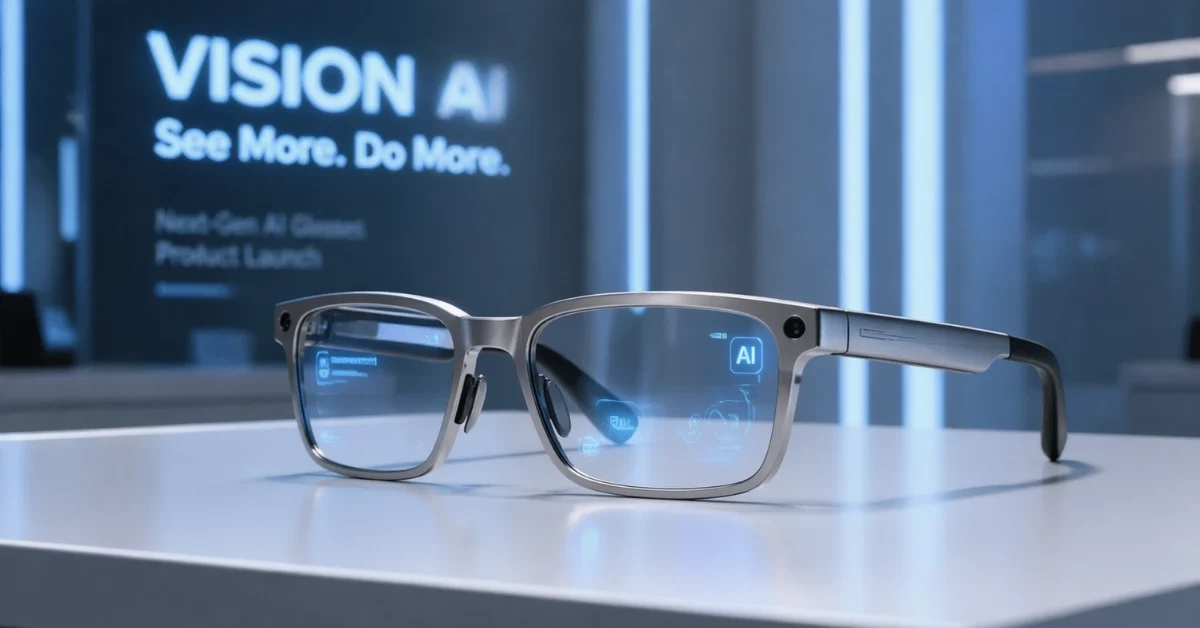
Huawei has officially entered the AI-powered smart eyewear race with the launch of its first AI Glasses, bringing a 12-megapixel camera, real-time translation, and a self-developed chip to a market already heating up fast. Starting at 2,499 yuan — roughly US$366 — the new wearable puts Huawei in direct competition with Meta, Alibaba, Xiaomi, and Rokid.
The launch took place at an official Huawei event, where He Gang, CEO of Huawei’s consumer business, personally demonstrated the device’s capabilities. According to Gang, the glasses can do far more than capture photos — they can scan QR codes for payments and even estimate and track food calories, making them one of the most feature-rich smart glasses available in China today.
A Camera That Actually Works on Your Face
At the heart of the Huawei AI Glasses is a 12MP super-sensing ultra-wide camera built on a 1/2.8-inch sensor. The device captures photos at up to 4096 × 3072 resolution and records video at 1920 × 1440 pixels at 30 frames per second. A standout spec is the 0.7-second quick capture, which makes it practical for on-the-go, first-person photography without fumbling for a phone.
Huawei has packed the imaging system with AI-powered features, including HDR Vivid support, RAW multi-frame fusion, automatic tilt alignment, and subject detection. The glasses also support first-person live streaming and video calls, enabling wearers to share their point of view in real time. Captured content syncs automatically to the paired phone’s gallery, and the device includes 64GB of internal storage — a notable advantage over competitors.
Powered by a Huawei-Made AI Chip
Unlike many smart glasses that rely on borrowed processors, the Huawei AI Glasses run on a self-developed chip designed specifically for eyewear. Huawei describes this chip as having a dual-engine distributed architecture that enables real-time AI processing on the device itself.
This in-house silicon powers the Xiaoyi AI assistant, which responds to both voice and shortcut activation. The system is capable of operating in noisy environments, picking up voice input as low as 47 dB. Whether you are on a crowded commute or in a busy café, the assistant is built to remain responsive. Xiaoyi can handle object and landmark recognition, AI photo queries, and contextual video-based interaction — all without needing to send data to a server first.
Real-Time Translation Across 20 Languages
One of the most practical features in the AI Glasses is its real-time translation system, which supports Chinese and 20 additional languages. This positions the device as a genuine travel and communication tool, not just a gadget.
The glasses run HarmonyOS and integrate with Huawei’s broader smart home ecosystem. Users can control smart home devices, set alarms, manage calls, and schedule tasks entirely through voice commands. A smart broadcast feature also delivers travel updates, making the glasses useful in transit situations.
Design Built for All-Day Wear
The AI Glasses come in three variants: a titanium semi-rim optical model in Titanium Silver Gray, a full-frame sunglass model in Shimmering Silver, and a full-frame optical model in Modern Black. The frame uses a golden triangle balance system to distribute weight evenly, keeping the device comfortable at around 35.5 grams.
A titanium alloy constant-force hinge allows for adaptive fit adjustment, while the three-sided wrap design improves stability during physical activity. The glasses carry an IP54 rating, meaning they are protected from dust and sweat — a practical consideration for everyday wearers.
Battery Life and Audio
Huawei’s AI Glasses pack a 258mAh battery that delivers up to nine hours of music playback, eight hours of calls, and 78 minutes of continuous live streaming. A full charge takes just 45 minutes via USB Type-C or magnetic contact charging. With a quick 10-minute charge, users can get up to three hours of music or capture around 200 photos.
The audio setup features dual open-ear sound units with Huawei Histen tuning, and a three-microphone array with DSP, MCU, and NPU processing for clear voice capture even in environments up to 80 dB. Bluetooth 6.0 and Wi-Fi 6 connectivity round out the package, offering a 250% improvement in signal transmission compared to previous generations.
Entering a Fiercely Competitive Market
Huawei’s debut arrives as China’s smart eyewear market has experienced explosive growth — shipments surged 35-fold in 2025 alone. Meta still dominates globally with an 85% market share, shipping 7.4 million units in 2025, a threefold increase driven by its Ray-Ban and Oakley-branded glasses, according to data from research firm Omdia.
In China, Huawei faces strong domestic competition from Alibaba, Xiaomi, and Rokid. Still, Huawei’s combination of an in-house chip, native HarmonyOS integration, and a genuinely capable camera system gives it a compelling value proposition. Pre-sales are already open, with official sales kicking off on April 25, 2026. The Titanium Silver, Gray, and Modern Black models are priced at 2,499 yuan, while the Shimmering Silver sunglass variant is priced slightly higher at 2,899 yuan.
