

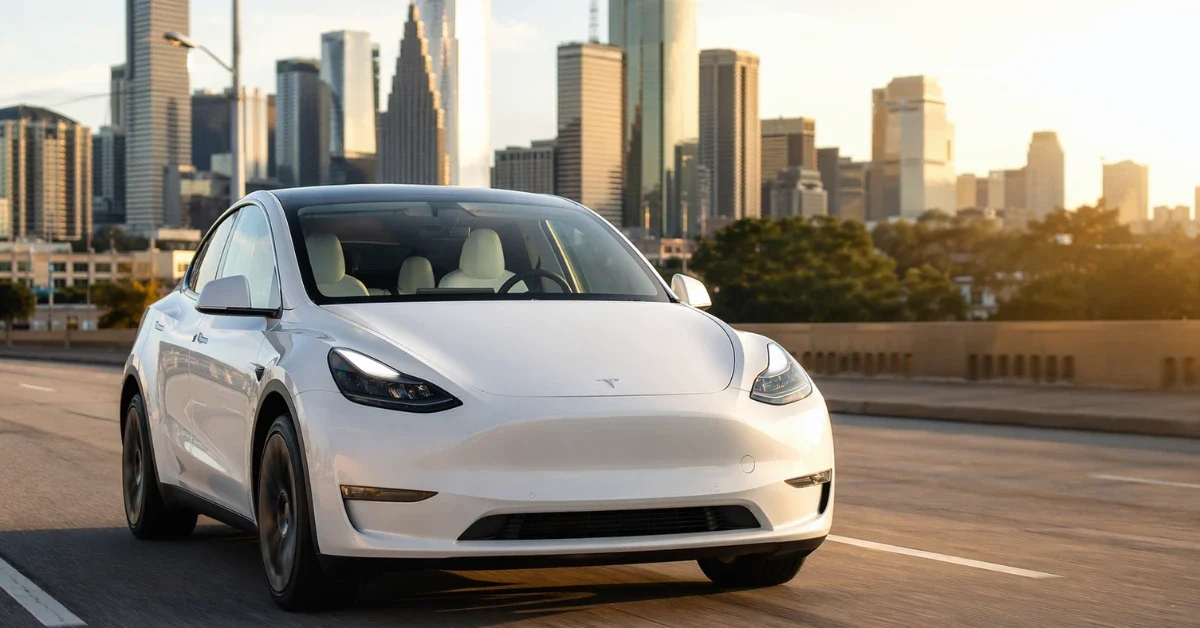
Tesla is taking its self-driving ambitions to two new Texas cities. The electric vehicle company announced on April 18, 2026, that its robotaxi service is now rolling out in both Dallas and Houston — marking its first expansion beyond Austin since the service launched there last year.
Tesla broke the news through a post on X, accompanied by a 14-second video showing its vehicles navigating city streets with no human driver or monitor in the front seat. The brief caption read: “Robotaxi is now rolling out in Dallas & Houston.” The post quickly racked up more than 25 million views.
Small Start, Big Ambitions
The rollout is still in its early stages, and the operational footprint in both cities is modest. The Houston service area covers roughly 25 square miles, while the Dallas zone appears centered around the Highland Park area. For comparison, Tesla’s Austin geofence has grown to around 245 square miles — but that expansion took nearly a year, starting from an initial 20-square-mile zone when the service first launched in June 2025.
Crowdsourced data from the Robotaxi Tracker website showed only a single active vehicle in each new city at the time of the announcement, compared to 46 vehicles logged in Austin. Tesla did not publicly disclose fleet size, pricing details, or whether the vehicles in the two new markets would carry safety monitors.
The Dallas rollout features Model Y electric vehicles equipped with Tesla’s latest self-driving software. The service is available daily from 6 a.m. to 2 a.m., with introductory pricing that reportedly undercuts competitor rates by about half. Currently, the app is only available for iPhone users, though an Android version is said to be in development.
A Passenger’s Rocky First Ride
Early real-world experiences paint a mixed picture. Chris Ramos, a 34-year-old Dallas resident, rushed to try the service on launch day after seeing posts about it online. He waited nearly two hours without being matched to a vehicle, and a Tesla customer support representative even told him the service hadn’t launched in his area yet.
When a ride finally came through, the car handled city streets smoothly — though it missed a right-on-red opportunity. Things took a more dramatic turn when the robotaxi missed an exit and found itself on a highway with traffic moving at 80 to 90 miles per hour. The vehicle began slowing down, as though preparing to pull over on the active freeway.
“Cars are flying by us. You don’t pull over on the highway unless it’s like a super emergency or something,” Ramos told Business Insider. A Tesla remote representative appeared to take control and kept the car moving in the slow lane until it could safely exit.
The trip didn’t end there. The car missed its final destination, circled a hotel repeatedly, and attempted to drop Ramos off about 2.6 miles from where he needed to be. The full 11-mile journey took 54 minutes and cost around $18. Despite all of this, Ramos remained optimistic about the technology’s long-term potential — though he said he would not recommend it to his grandmother.
Safety Record and Competitive Pressure
The expansion comes with some safety questions still unresolved. Tesla reported 15 crash incidents to the National Highway Traffic Safety Administration since its Austin launch. According to a February regulatory filing, Austin robotaxis had been involved in 14 crashes since the service began. One incident from July 2025 was later upgraded to include a hospitalization — a detail Tesla did not publicly announce at the time.
The service also currently shuts down during rain, which raises a specific concern in Houston, a city that averages over 100 rainy days per year.
Tesla faces established competition in both new markets. Waymo, backed by Alphabet, has been operating fully driverless vehicles in Houston and Dallas since February 2026, and is currently delivering 500,000 paid robotaxi rides per week across ten U.S. cities nationwide.
Wider Market and What’s Next
The timing of the expansion is notable. Tesla is set to report its first-quarter 2026 earnings on April 22, and the robotaxi rollout adds a forward-looking narrative to that announcement. The broader autonomous ride-hailing market is projected to reach $168 billion by 2035, according to Counterpoint Research, which identifies the U.S. as the key hub of innovation.
Tesla’s Austin operation continues to serve as the proving ground for this technology, and the company has hinted at more expansion through a video teasing a “Golden Era” for its upcoming Cybercab — a self-driving, lower-cost electric vehicle seen as a central part of Tesla’s future strategy.
