

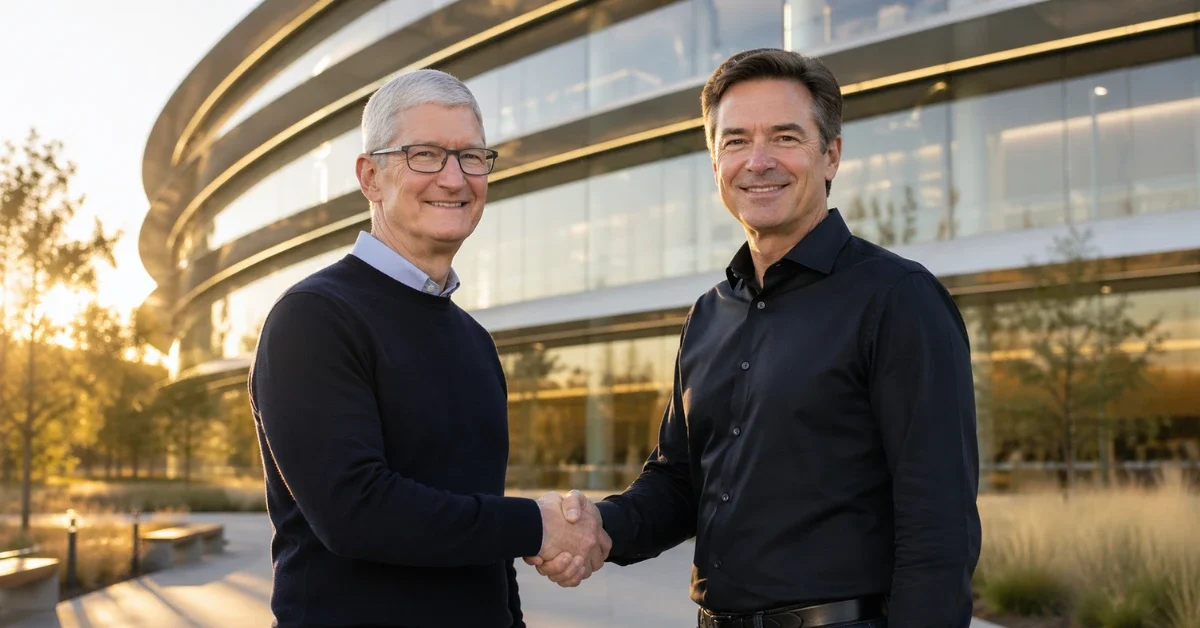
Apple is entering a new chapter. The company officially announced on April 20, 2026, that John Ternus will become its next chief executive officer, succeeding Tim Cook, who will transition to executive chairman. The change takes effect on September 1, 2026, and was approved unanimously by Apple’s board of directors.
Cook, 65, will remain CEO through the summer to help ensure a smooth handover. As executive chairman, he will continue representing Apple in key areas, including engaging with policymakers around the world.
A Transition Years in the Making
Apple described the leadership change as the result of a thoughtful, long-term succession planning process — not a sudden or reactive decision. The announcement came as a surprise to Wall Street; however, Apple shares dipped less than 1% in late trading on the day of the announcement.
Cook, who joined Apple in 1998 and took over as CEO in 2011, reflected on his time leading the company with emotion. “It has been the greatest privilege of my life to be the CEO of Apple and to have been trusted to lead such an extraordinary company,” he said in an official statement. He praised Ternus directly, describing him as someone with “the mind of an engineer, the soul of an innovator, and the heart to lead with integrity and with honor.”
Arthur Levinson, who has served as Apple’s non-executive chairman for the past 15 years, will transition to the role of lead independent director on September 1. Ternus will simultaneously join the company’s board of directors.
The Cook Legacy: From $350 Billion to $4 Trillion
Few leaders in corporate history have overseen growth at the scale Tim Cook managed at Apple. When he became CEO in 2011, the company carried a market capitalization of roughly $350 billion. Today, that figure stands at $4 trillion — an increase of more than 1,000%. Annual revenue also nearly quadrupled, climbing from $108 billion in fiscal year 2011 to more than $416 billion in fiscal year 2025.
During his tenure, Apple launched entirely new product categories, including Apple Watch, AirPods, and Apple Vision Pro. The company’s services business — covering iCloud, Apple Pay, Apple TV+, and Apple Music — grew to become a $100 billion-plus operation on its own, equivalent to a Fortune 40 company. Apple also expanded its global reach to more than 200 countries and territories, operates over 500 retail stores, and grew its active installed base to more than 2.5 billion devices.
Cook also championed values-driven leadership, reducing Apple’s carbon footprint by more than 60 percent below 2015 levels while revenue nearly doubled. His advocacy for user privacy helped set an industry standard that continues to separate Apple from many of its competitors.
Who Is John Ternus?
Ternus, 50, has spent virtually his entire professional career at Apple. He joined the company’s product design team in 2001, became a vice president of Hardware Engineering in 2013, and rose to senior vice president in 2021.
His fingerprints are on some of Apple’s most iconic products. He played a central role in the introduction of iPad and AirPods, and has overseen multiple generations of iPhone, Mac, and Apple Watch. More recently, his team launched the iPhone 17 lineup — including the iPhone 17 Pro, iPhone 17 Pro Max, and the ultra-thin iPhone Air — as well as MacBook Neo, an all-new laptop designed to bring the Mac experience to more users globally.
Ternus holds a bachelor’s degree in Mechanical Engineering from the University of Pennsylvania and previously worked as a mechanical engineer at Virtual Research Systems before joining Apple.
In his statement, Ternus acknowledged the weight of the moment. “I am profoundly grateful for this opportunity to carry Apple’s mission forward,” he said, noting that he had the rare privilege of working under both Steve Jobs and Tim Cook during his career.
What Comes Next for Apple
Ternus steps into the CEO role at a pivotal moment for the tech industry. Apple has faced pressure for moving more slowly than rivals like Google and OpenAI in the artificial intelligence race. The company has already begun integrating advanced AI tools into its ecosystem through external partnerships.
His deep product background signals that hardware innovation will remain central to Apple’s strategy going forward. Meanwhile, Cook’s continued presence as executive chairman is expected to offer stability, particularly in areas of regulatory affairs and global policy engagement.
Board member Arthur Levinson captured the tone of the moment well: the transition is not just about changing who sits in the CEO’s chair — it is about ensuring that what Apple has built over decades continues to move forward with the same commitment to quality, values, and innovation that has defined it.
